—

F50

The speed name adidas retired, then brought back

The F50 was adidas's speed silo — most famously the adizero F50 era — before the name was retired and the speed slot passed to the X line (X Speedportal, X Crazyfast). In 2024 adidas relaunched the F50 name after a nine-year gap, folding the X speed lineage back under it, now fronted by Lamine Yamal.

2024

03

F50 — the lineage

Every generation of the boot, in order — what changed, who wore it, and a photograph where a freely-licensed one exists. Generation notes are in English for now.

2004
adidas F50

Where the speed line begins. adidas launched the F50 around Euro 2004 as a deliberately light, stripped-down boot for quick attacking players, at a time when most top boots were still built heavy for power and protection. Even the name is a countdown: the "F" is for football and the "50" for the fifty days left until Euro 2004 when it launched. It set the whole idea the silo would chase for the next twenty years: take weight off the foot so the player can get to the ball first.

The Predator was adidas's power boot. The F50 was the opposite bet — that the next advantage was not a boot that did more to the ball, but a boot you barely noticed while you ran. Wingers made it their weapon of choice.

Worn by: Arjen Robben

Sources: [1]

No freely-licensed photograph of this generation yet.
2006
F50 TUNIT

The modular boot, and still the boldest thing the line ever tried. Made widely available ahead of the 2006 World Cup, the TUNIT split the boot into three parts the player assembled themselves — the upper, the chassis (soleplate) and the studs — each sold separately, so you could mix a lightweight upper onto a firm-ground chassis or swap studs for a soft pitch without buying a whole new pair. No mainstream boot had offered that much customisation before.

One boot could not be perfect for every pitch or every player. Instead of guessing, adidas let the player build the exact combination they wanted — a genuinely different answer that no rival matched.

Worn by: Lionel Messi

Sources: [1]

No freely-licensed photograph of this generation yet.

2010
adizero F50

The one everyone remembers. adidas stripped the boot down to a single-layer synthetic upper on its SprintFrame soleplate and got the weight to about 165 grams — the lightest football boot in the world at the time. Messi wore them at the 2010 World Cup and said he could barely feel them on his feet. It reset what "light" meant, and every speed boot after it — from adidas and its rivals — was chasing this number.

A boot that weighs less is a boot you can accelerate and change direction in faster. The adizero pushed that trade-off further than anyone had, betting that a player would give up some padding for that quickness. Messi's game made the case for them.

Worn by: Lionel Messi

Sources: [1][2]

No freely-licensed photograph of this generation yet.

2011
adizero F50 miCoach

The first football boot with a brain. adidas cut a small cavity into the sole to hold the miCoach SPEED_CELL, a sensor that recorded how far and how fast you ran — top speed, number of sprints, distance at high intensity — and beamed it to a computer afterwards so you could compare your numbers to a professional's. The performance data that only elite clubs used to measure was suddenly sitting under an amateur's foot.

adidas was already selling the lightest boot; the next thing to add was not lighter but smarter — turning the boot itself into a training tool, years before fitness trackers were on every wrist.

Worn by: Lionel Messi

Sources: [1][2]

No freely-licensed photograph of this generation yet.

2015
adizero F50 (final generation)

The last boot to carry the F50 name for almost a decade. By 2015 the adizero F50 was a mature, refined speed boot — but adidas was about to reorganise its whole range, and in the middle of that year it discontinued the F50 outright, closing an eleven-year run before the name went into storage.

Not a technical leap but a turning point: adidas had decided the speed silo needed a clean restart under a new identity, so it retired a name football had known since 2004.

Sources: [1][2]

No freely-licensed photograph of this generation yet.

2015
adidas X15

The rename. adidas retired the F50 and rebuilt its speed boot as the X, the first in a new family aimed at fast, direct attackers. Same job as the F50 — get the quick player to the ball first — but under a new name and a more structured, aggressive design. From here the speed line ran as "X" for nine years, which is why the boots below say X on the side but belong to the very same lineage.

adidas split its old ranges into clearer roles — X for speed, ACE for control — so a buyer could pick a boot by the way they played. The F50's job did not disappear; it just put on a new badge.

Sources: [1]

No freely-licensed photograph of this generation yet.

2018
adidas X18

The X went laceless. The X18+ dropped the laces entirely, wrapping the foot in a stretchy SpeedMesh upper so the front of the boot was one clean, seamless striking surface with nothing to knock the ball off line. Taking the laces off a speed boot — and trusting the fit to hold without them — was the boldest change of the X era.

Laces are a bump on the exact part of the boot you hit the ball with. Removing them gave a cleaner contact and a sleeker, faster-looking boot — if adidas could make it grip the foot securely without them, which is what this generation set out to prove.

Sources: [1]

No freely-licensed photograph of this generation yet.

2021
X Speedflow

adidas rebuilt the X around a bendy carbon plate. The Speedflow used a Carbitex soleplate that stayed stiff for push-off but flexed where the foot needed it, on top of a thin Primeknit upper — tuned so the boot snapped the player forward out of a sprint rather than just being light.

By 2021 every speed boot was already feather-light, so lightness alone no longer won. The new battleground was energy return: making the sole actively help the player accelerate, not just weigh less.

Worn by: Mohamed Salah

Sources: [1][2][3]

No freely-licensed photograph of this generation yet.

2022
X Speedportal

A sharper, more aggressive take on the Speedflow idea. The Speedportal paired a Speedskin upper with a redesigned soleplate aimed at both straight-line speed and quick changes of direction, with a spiky, angular look meant to signal pure pace. It is one of the two X generations the pricing engine still tracks under the F50 silo.

Real speed on a pitch is not only running fast in a line; it is stopping, turning and going again. This generation tried to serve both at once rather than optimising for the straight sprint alone.

Worn by: Mohamed Salah

Sources: [1][2]

No freely-licensed photograph of this generation yet.

2023
X Crazyfast

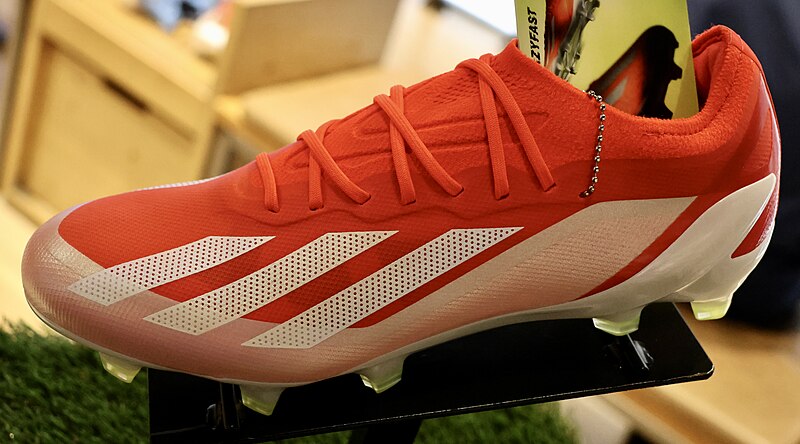
The last boot to wear the X name. The Crazyfast pushed the speed formula to its minimalist extreme — a thin, semi-translucent Aeropacity Speedskin upper over a new Aeroplate soleplate that dropped even the carbon insert to shave off a few more grams — and it turned out to be the end of the road for X: the following year adidas brought the F50 name back and the X was gone.

After nine years the X had taken the "lighter, snappier, more minimal" idea about as far as a name could carry it. adidas judged that the story needed a reset — and that the reset should be a return to where the speed line started.

Worn by: Mohamed Salah

Sources: [1][2]

adidas X Crazyfast Elite (2023) — the last boot to carry the X name, on display at adidas Orchard Road, Singapore.
adidas X Crazyfast Elite (2023) — the last boot to carry the X name, on display at adidas Orchard Road, Singapore.📷 Pangalau · CC BY-SA 4.0
current
2024
F50 (revival)

The name came home. After nine years as the X, adidas revived the F50 in 2024 as part of its Advancement Pack, built on a new Sprintframe 360 soleplate for speed in every direction and a light Fibertouch upper, with a top-tier F50+ using Lightstrike Pro foam — the same springy material from adidas running spikes — for extra push. It arrived for Euro 2024 and the Copa America and put the F50 back on the biggest stages.

A name like F50 carries twenty years of meaning — Messi, the 165-gram boot, the smart boot. Bringing it back tied the newest speed technology to that history in a way the "X" badge never could, telling players this was the real heir to the original.

Worn by: Lionel Messi, Lamine Yamal, Son Heung-min, Florian Wirtz, Rafael Leão

Sources: [1][2]

No freely-licensed photograph of this generation yet.

02

F50 — the full album

Every generation, one slot each. Boot names stay in English, and some archive notes are still English-only — those are marked. Scroll the row.

2024
The speed name adidas retired, then brought back
The F50 was adidas's speed silo — most famously the adizero F50 era — before the name was retired and the speed slot passed to the X line (X Speedportal, X Craz…
launch
—
F50
A thin, lightweight synthetic with targeted support — the F50 is pure speed and agility, the relaunch of a name adidas retired for nine years.
€223.99
—
F50 X Crazyfast
adidas's speed silo before the F50 name returned; light synthetic, aggressive plate.
—
—
F50 X Speedportal
The Speedportal speed silo; thin synthetic upper for pace.
—